

Token-based pricing charges you for how many tokens a service processes, and cost scales with input tokens plus output tokens (plus cached tokens where a provider supports them). The formula behind almost every AI bill you'll see is: cost = (input tokens × input rate) + (output tokens × output rate) + (cached tokens × cached rate). That's the whole model. The complexity comes from estimating those token counts before you're staring at an invoice you didn't expect.
If you're evaluating or operating a token-priced product, here's what to do immediately:
- Set up monitoring first. You can't budget what you can't measure, so instrument token usage per feature before you negotiate rates.
- Choose hybrid pricing if predictability matters. A flat base fee plus metered overage protects both your forecast and your customer's trust.
- Brief finance early on revenue recognition. Prepaid credit packs and pay-as-you-go tokens hit the books differently under ASC 606, and your finance team needs lead time to build the right accounting treatment.
Key Takeaways
Token-based pricing works when accurate metering, clear per-1M-token rate visibility, and ASC 606-aware revenue recognition are combined with engineering-level cost controls.
| Point | Details |
|---|---|
| Cost formula stays constant | Cost equals input tokens times input rate, plus output tokens times output rate, plus cached tokens times cached rate. |
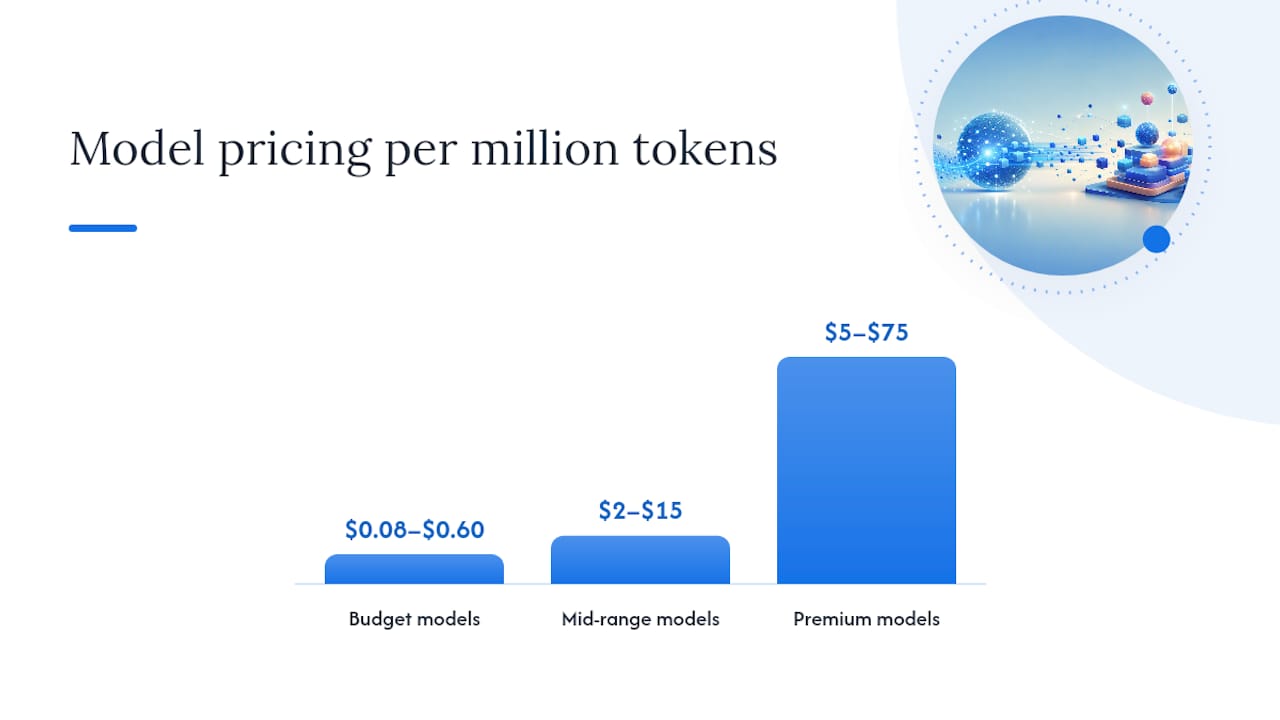
| Rates vary by model tier | Budget, mid-range, and premium models span roughly $0.08 to $75 per million tokens depending on the provider. |
| Credit packs create deferred revenue | Prepaid tokens require breakage estimation under ASC 606; per-token billing recognizes revenue as consumed. |
| Agents are budget consumers | Background agent loops silently accumulate token costs and need the same caps as human-initiated requests. |
| Sanad offers transparent per-token billing | Sanad's pay-as-you-go model pairs usage analytics and team workspace controls across API, VS Code, and CLI access. |
Table of Contents
- What Is a Token, and How Does Tokenization Affect Your Bill?
- How Do Rate Tables and Token Math Actually Work?
- Which Token Pricing Model Fits Your Product?
- What Do Finance Teams Need to Track for Accurate Billing?
- How Do You Keep Token Costs Under Control?
- Is Token Pricing Right for Your Product?
- How Sanad Implements Token Billing for Developer Workflows
- Where Is Token Pricing Headed Next?
- Manage Token Spend With Full Visibility on Sanad
- Sources
What Is a Token, and How Does Tokenization Affect Your Bill?
A token is a chunk of text, roughly three to four characters in English, that a model's tokenizer splits your input and output into before processing. Models don't read words. They read tokens, and every tokenizer draws the lines differently depending on the language, the vocabulary it was trained on, and the specific model family you're calling.
This matters more than it sounds like it should. The same sentence in English, French, and Japanese can tokenize into wildly different counts, and two providers running comparable models can bill you differently for identical prompts simply because their tokenizers split the text differently. If you're comparing rate cards across providers, you're not comparing apples to apples unless you also account for tokenizer variance.
Three categories of tokens show up on almost every bill:
- Input tokens — the prompt, system instructions, and any context you send to the model.
- Output tokens — what the model generates back to you, usually priced higher per token than input because generation is more compute-intensive.
- Cached input tokens — repeated context (a long system prompt, a codebase snippet reused across calls) that some providers bill at a steep discount because they don't have to reprocess it from scratch.
Here's a quick illustration. A short customer support question, something like "How do I reset my password?" plus a modest system prompt, might run 40 to 80 input tokens. The model's response, two or three sentences, adds another 50 to 100 output tokens. That single exchange costs a fraction of a cent on most mid-tier models. Now scale that to a document summarization task: a 10-page PDF converted to text can easily hit 6,000 to 8,000 input tokens, with a compressed summary output of 300 to 600 tokens. The input cost dominates, which is exactly why cached-input pricing exists. If you're re-summarizing variations of the same document, or re-running an agent loop against the same codebase, caching that repeated context is often the single biggest lever you have.
Pro Tip: Run a test batch of your five most common request types through a tokenizer preview tool before committing to a pricing tier. Most teams underestimate their input token counts by 30 to 50 percent because they forget to count system prompts and conversation history, not just the user's message.
Coding assistants complicate this further. A single "review this pull request" request might pull in an entire file, related test files, and a chunk of conversation history for context, pushing input tokens into the thousands before the model generates a single line of feedback. If you're running background agents that loop repeatedly, checking build status, rerunning tests, iterating on a fix, every loop iteration adds its own input and output tokens, and those add up fast without anyone noticing until the invoice arrives.
How Do Rate Tables and Token Math Actually Work?
Providers publish rates per million tokens, not per token, because a single token costs a fraction of a cent and nobody wants to read a price tag with six decimal places. The canonical formula stays the same regardless of the model you're using:
Cost = (input tokens ÷ 1,000,000 × input rate) + (output tokens ÷ 1,000,000 × output rate) + (cached tokens ÷ 1,000,000 × cached rate)
Rates vary enormously by model tier. Explainers tracking the market report budget models priced around $0.08 to $0.60 per million tokens, mid-range models in the $2 to $15 per million range, and premium reasoning models running $5 to $75 per million tokens depending on the provider and context length. Treat these as illustrative bands, not fixed benchmarks. Actual rate cards shift often, and providers frequently list input, cached input, and output as three distinct line items, the way OpenAI's enterprise rate card does for its ChatGPT Enterprise token pricing.
Here's how that math plays out across three common scenarios:
The background agent case deserves attention because it's where teams get surprised. A single agent loop looks cheap. Twenty loops running unattended overnight, multiplied across fifty active users, turns a rounding error into a real line item. This is exactly the operability risk that shows up when long-running agents consume tokens silently in the background, and it's why treating agents as first-class budget consumers matters as much as tracking human-initiated requests.
A few multipliers push effective rates higher than the base card suggests:
- Long-context processing. Requests that exceed a model's standard context window (often 32K or 128K tokens) frequently carry a premium rate for the tokens beyond that threshold.
- Fast-mode or priority processing. Providers offering low-latency inference typically charge more per token than standard throughput tiers.
- Regional or dedicated-capacity processing. Running inference in a specific region or on reserved capacity can carry its own rate structure separate from the shared-pool default.
None of these multipliers are hidden fees exactly, they're published, but they're easy to miss if you're pricing a workload against the headline rate instead of the rate that actually applies to your traffic pattern.
Which Token Pricing Model Fits Your Product?
Four structural variants dominate the market, and each one shifts risk between you, your customer, and your finance team in a different direction.
Per-token pay-as-you-go bills exactly what gets consumed, nothing more. It's the most transparent model for the customer, since the invoice maps directly to usage, but it's the hardest to forecast. A customer running a spiky workload, heavy one week, quiet the next, sees their bill swing accordingly, which makes budget approval conversations harder on their end.
Credit packs flip that trade-off. The customer pays up front for a block of tokens, giving you cash in hand and giving them a spending ceiling they understand. The catch is on your books: unused credits sit as deferred revenue, and you need a defensible breakage estimate for the portion customers never redeem. Zenskar's guidance on token-based finance treats this as one of the harder revenue recognition problems that AI-native billing introduces, since token consumption doesn't follow the neat monthly cadence traditional SaaS subscriptions do.
Per-action pricing charges for outcomes, a completed code review, a resolved support ticket, a generated report, rather than raw tokens. It aligns cost to value far better than a token count ever will, but it's measurement-heavy: you need reliable instrumentation to define what counts as a completed "action" and to prevent partial or failed attempts from silently eating your margin.
Hybrid models combine a fixed base fee with metered overage past an included allotment. Stripe's documentation on usage-based pricing implementations walks through exactly this pattern, fixed-fee-plus-overage alongside pure pay-as-you-go and credit burndown, as the three structures most usage-billing platforms need to support. Hybrid pricing gives you a predictable revenue floor while still capturing upside from heavy users, but it adds billing system complexity: you're now tracking an allotment, a reset cadence, and an overage rate simultaneously.
| Model | Cash flow timing | Forecasting difficulty | Finance complexity |
|---|---|---|---|
| Per-token pay-as-you-go | Cash arrives after consumption | High for customer, moderate for you | Revenue recognized as consumed |
| Credit packs | Cash arrives up front | Low for customer, moderate for you | Deferred revenue plus breakage estimation |
| Per-action | Cash arrives after outcome delivered | Moderate | Requires reliable action-completion instrumentation |
| Hybrid (base + overage) | Base cash up front, overage after use | Low to moderate | Tiered metering plus allotment tracking |
On the accounting side, the rule that matters most: cash collected before consumption (credit packs, prepaid balances) is deferred revenue until the customer actually uses it. ASC 606 guidance requires you to estimate the portion of purchased credits that will never be redeemed, known as breakage, and recognize that estimate systematically rather than waiting for credits to formally expire. Per-token consumption avoids this problem almost entirely, since you recognize revenue as tokens are consumed, which is one reason some finance teams prefer pure usage billing over prepaid packs despite the cash flow trade-off.
What Do Finance Teams Need to Track for Accurate Billing?
Token billing only works if your metering pipeline is trustworthy, and that trustworthiness rests on four operational pillars finance and engineering need to agree on before launch.
- Identity and attribution. Every token consumed needs a clear owner, tied to a user, a team, an API key, or a specific feature, so you can bill correctly and answer disputes without guesswork.
- Real-time aggregation. Token counts need to roll up continuously, not in a nightly batch job, especially if you're offering usage alerts or hard spending caps that need to trigger before a customer blows past their limit.
- Revenue recognition rules by model type. Per-token consumption recognizes revenue as it happens; prepaid credit packs require a breakage estimate and deferred revenue schedule, a distinction Zenskar's CFO guidance treats as the central accounting challenge in token-based products.
- Audit trails and reconciliation. Every billed token needs to be traceable back to a specific API call or session, both for customer disputes and for your own internal margin analysis when a model provider changes their underlying rate card.
Forecasting token revenue is genuinely harder than forecasting seat-based subscription revenue, because usage isn't a fixed number you can multiply by headcount. Baseline commitments help: if you can get customers to commit to a minimum monthly token volume, even a modest one, you get a revenue floor to build your forecast around. Smoothing techniques, rolling 30 or 90-day usage averages instead of raw daily counts, reduce the noise from any single spiky day. Usage-based billing data, when it feeds back into your CRM and forecasting systems, also gives your revenue team a genuinely useful signal for renewal conversations, since Salesforce's guidance on usage-based billing notes that consumption trends often predict expansion or churn risk before a renewal date ever shows up on the calendar.
Pro Tip: Build your breakage estimate from actual redemption history, not from a round number that looks reasonable. A 10% breakage assumption pulled from nowhere will not survive an audit; a breakage rate calculated from twelve months of actual credit pack expirations will.
Contract changes are the quiet failure point most teams miss. When a customer upgrades mid-cycle, switches from credit packs to pay-as-you-go, or negotiates a custom rate, your metering and billing system needs a clean cutover point. Without one, you'll find yourself reconciling two different rate structures against a single usage stream, which is exactly the kind of manual patchwork that turns an audit into a multi-week project.
How Do You Keep Token Costs Under Control?
The unsettling part of usage-based billing is that it has more than tripled in adoption, rising from 27% to 46% of SaaS companies between 2018 and 2022, because it aligns what customers pay to what they actually use. That alignment is a strength for the business but it means the burden of cost control shifts partly onto the customer's own engineering discipline.
Track these metrics on a dashboard, not in a spreadsheet you check once a month:
- Tokens per feature. Which parts of your product consume the most tokens, and does that consumption map to the value customers get from that feature?
- Token burn rate. Are you trending toward a monthly budget overrun before the month is even half over?
- Cost per action. What does it actually cost you to complete one code review, one support resolution, one generated report, once you divide total token spend by completed outcomes?
Budgeting approaches split into three practical tiers. Hard caps stop processing the moment a limit is hit, protecting your budget completely but risking a broken user experience mid-task. Soft caps paired with alerts let usage continue past the threshold while notifying an owner, trading some cost risk for continuity. Auto top-up versus manual invoicing is really a cash flow decision: auto top-up keeps usage flowing without interruption but requires trust in your own monitoring to prevent runaway spend, while invoicing gives you a manual checkpoint at the cost of friction.
On the engineering side, a handful of tactics consistently cut token spend without cutting output quality: trimming system prompts to only what's necessary, batching similar requests instead of firing them one at a time, caching repeated context so you're not reprocessing the same document or codebase on every call, and setting explicit response-length limits so the model doesn't generate three paragraphs when two sentences would do.

Pro Tip: Tag every API call with a team or feature identifier at the code level, not after the fact in a billing dashboard. Retroactive cost allocation is a guessing game; tagged-at-source allocation is a fact.
Governance closes the loop. Assign quota ownership to specific teams, not to "engineering" broadly, and make sure whoever owns a feature's token budget also sees the dashboard that tracks it. Accountability without visibility just produces frustration when the invoice arrives.
Is Token Pricing Right for Your Product?
Token pricing fits best when workloads are genuinely variable, when you're building an API-first product where usage patterns differ wildly customer to customer, or when your product involves agent and automation workflows where a single customer's consumption can spike tenfold depending on how many background loops they're running.
It fits poorly, or fits better as a hybrid, in a few recognizable situations:
- Predictable, seat-based workloads. If usage per seat is roughly consistent, a flat per-seat price is simpler for everyone and avoids the forecasting headache entirely.
- Budget-sensitive enterprise customers. Procurement teams often prefer a number they can put in a purchase order over a variable bill, even if the variable bill would sometimes be cheaper.
- Early-stage products without usage data. You can't set sane token rates or caps without knowing what typical usage looks like, so pure consumption billing on a brand-new product is a guess dressed up as a pricing model.
If you do go with token pricing, or a hybrid version of it, a few negotiation levers reduce risk on both sides: committed-volume discounts that reward customers for predictable minimum spend, rollover allowances so unused tokens in a credit pack don't simply evaporate at month's end, rate caps that protect customers from open-ended exposure during unexpected usage spikes, and custom billing terms for enterprise accounts that need invoicing cadence or currency handling outside your standard self-serve flow.
How Sanad Implements Token Billing for Developer Workflows
Sanad's own billing model is a working example of most of the guidance above. Sanad runs on transparent pay-as-you-go pricing, so you're charged for the tokens your models actually consume, whether you're calling Sanad 0.1 for fast iteration or reaching for a heavier reasoning model like DeepSeek V4 Pro on a complex refactor.
That token consumption surfaces through the same channels you're already working in:
- API access for direct integration into CI pipelines, background agents, or custom tooling, with token usage tracked per call.
- A Visual Studio Code extension that lets you see model selection and usage in your editor without switching context.
- A command-line interface for scripting and automating coding tasks against any model in the catalog.
- Usage analytics dashboards that map directly to the monitoring checklist above, tokens per feature, burn rate, cost per action, without building that instrumentation yourself.
For engineering teams managing multiple developers or projects, Sanad's team workspace controls handle the governance side: quota assignment per team, model management so you're not overpaying for a premium model on tasks a lighter one handles fine, and billing oversight that keeps token spend visible to whoever owns the budget, not buried in a monthly invoice nobody reads closely until it's too late.
Where Is Token Pricing Headed Next?
Token pricing works today because it's honest about what's still uncertain: nobody, including the model providers themselves, has fully mapped the relationship between raw compute cost and business value delivered. Charging per token is a defensible cost-plus stance while that mapping gets sorted out. Pricing analysts have made this case directly: treat token pricing as a transitional model, not a permanent one.
The direction of travel is toward value-based metrics, decisions automated, hours of engineering time recovered, tickets resolved without escalation. If you're building or buying a token-priced product, don't wait for the industry to make that shift for you. Pilot per-action pricing on a subset of customers now, even informally, and start building the value proxies you'll need when token counts stop being the primary conversation.
For product and finance leaders, the one-step recommendation is simple: pick one high-usage customer segment and start measuring outcomes alongside tokens this quarter, not next year.
— Jubba
Manage Token Spend With Full Visibility on Sanad
Sanad gives you the transparency this article just walked through, without building the monitoring stack yourself. Every token you spend across Sanad 0.1, GLM 5.2, GLM 4.7 Flash, GPT OSS 120B, DeepSeek V4 Flash, and DeepSeek V4 Pro shows up in usage analytics you can act on immediately, not reconstruct after the invoice lands.
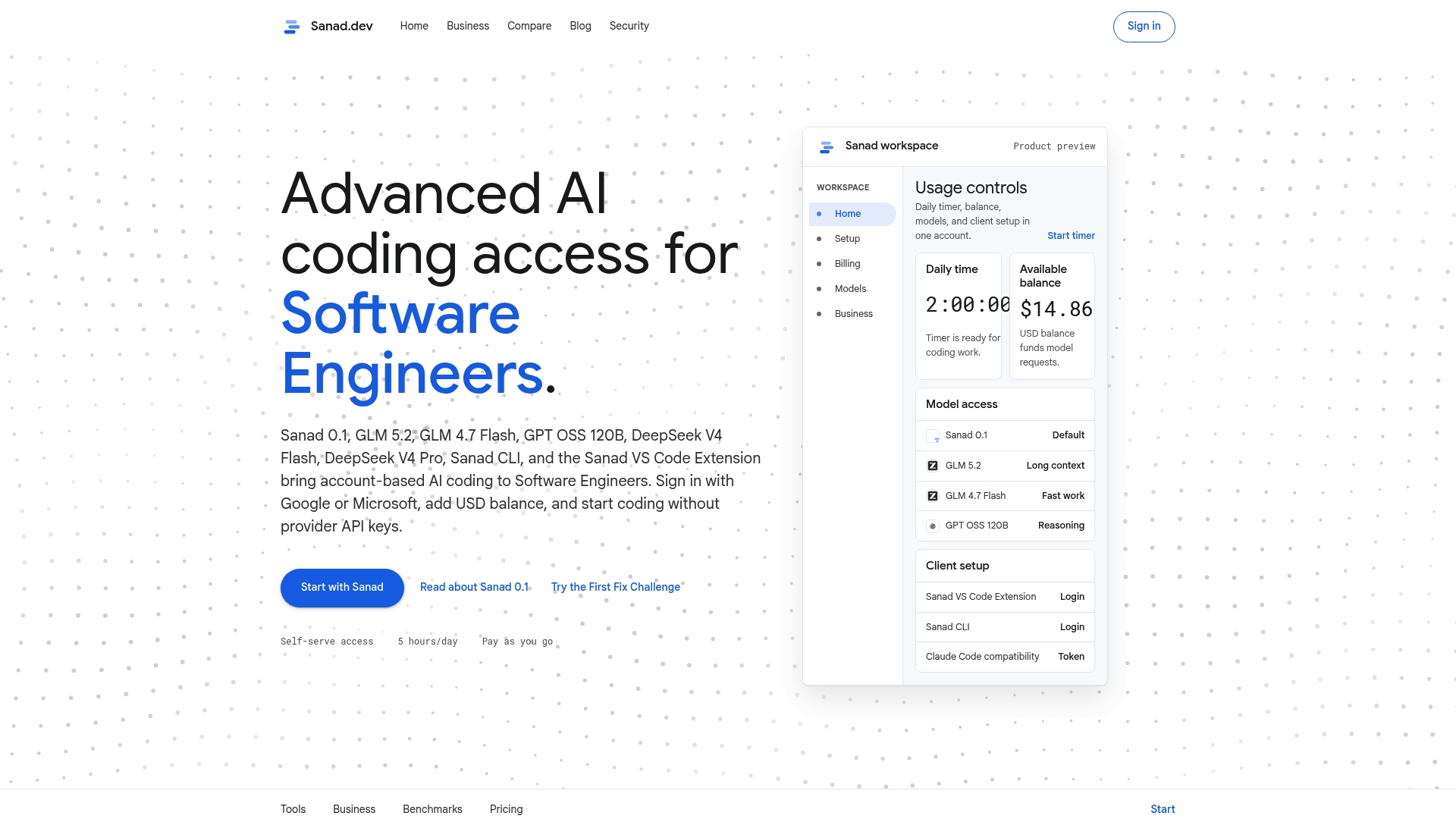
Pick the model that fits the task instead of overpaying for reasoning power on a quick syntax fix, and let your team workspace controls handle quota and billing oversight so no single developer's background agent loop turns into a surprise line item. Whether you're calling models through the API, working inside the Visual Studio Code extension, or scripting from the command line, the same pay-as-you-go token billing applies everywhere, with no separate contract to negotiate for each surface. Set up your account and put a spending cap in place before you run your first heavy workload. Start at Sanad and check your current rate card before your next sprint.
Sources
- What Is Token-Based Pricing for AI Models — MindStudio
- Token-Based Pricing for AI Products: The CFO's Guide 2026 — Zenskar