

Secure API key management means every key is scoped to a single purpose, stored in a central secrets manager instead of code or config files, rotated on a schedule, and watched for anomalies. Two things make this work in practice: someone owns every key, and revocation is tested before it's needed. Get those two right and the rest of the checklist falls into place.
TL;DR:
- Owners must be assigned to every API key to ensure accountability and enable effective rotation and revocation.
- Secrets should be stored in a managed vault with tight scope, shorter lifetimes, and automatic rotation to limit exposure.
- Keys should be issued one at a time, with a focus on discipline during creation and sharing limited to vault-to-vault exchanges or short-lived tokens.
- Monitoring should track usage patterns like spikes or unusual locations, and incident response must include immediate revocation and postmortem analysis.
- Transferring to stronger authentication methods such as OAuth 2.0, OIDC, or mTLS is essential for high-risk or sensitive workloads.
Table of Contents
- What Does Good API Key Management Look Like In Practice?
- How Should You Store, Rotate, and Scope Keys?
- How Do You Give Out Keys Without Leaking Them?
- What Should You Monitor, and What's Your Incident Plan?
- How Do You Keep Secrets Safe in CI/CD Pipelines?
- When Should You Replace API Keys With Something Stronger?
- How Platform Tooling Reduces Key Management Friction
- What Actually Matters More Than People Think
- A Developer-Focused Alternative For Managing Model Access
- Where to Go Deeper on Key Security Standards
- Sources
What Does Good API Key Management Look Like In Practice?
You don't need a security team of twenty to get this right. You need a short list of controls, applied consistently, and a habit of checking them.
Here's the priority order that actually moves the needle:
- Inventory every key and assign an owner. You can't rotate, restrict, or revoke what you don't know exists. Unowned keys are the single biggest source of long-term exposure, and OWASP's API Security Project points to weak lifecycle controls, not weak key formats, as the real failure point.
- Move secrets out of code and into a managed vault. Environment files and hardcoded strings get committed to Git more often than teams like to admit.
- Issue per-service or per-partner scoped keys instead of one master key shared across integrations.
- Automate rotation, and actually test revocation. A rotation script that's never been run under pressure is a rotation script you can't trust.
- Apply IP and application restrictions, then monitor usage against a baseline so deviations stand out immediately.
Do these five things and you've closed off the paths that cause most real-world key leaks.
How Should You Store, Rotate, and Scope Keys?
Storing a key in a .env file feels fast, until that file ends up in a Docker image or a support ticket screenshot. A secrets manager solves the problem a plaintext file can't: it centralizes access control, logs every read, and lets you rotate a value without redeploying code that references it. AWS Secrets Manager recommends storing each API key as its own secret, encrypted with a KMS-backed key, so a breach in one system doesn't cascade into every credential you own.
Scoping is where most teams stop too early. A scoped key should restrict by resource, by IP range, and by expiration date, not just by a vague "read-only" label. NuGet's scoped API keys model this well: you can scope a key to a glob pattern covering only the packages a given integration needs, and the plaintext value is shown exactly once at creation. That single design choice, tighter scopes plus shorter lifetimes, is also why Microsoft has been reducing default key lifetimes on NuGet: shorter windows shrink the blast radius when a key leaks.
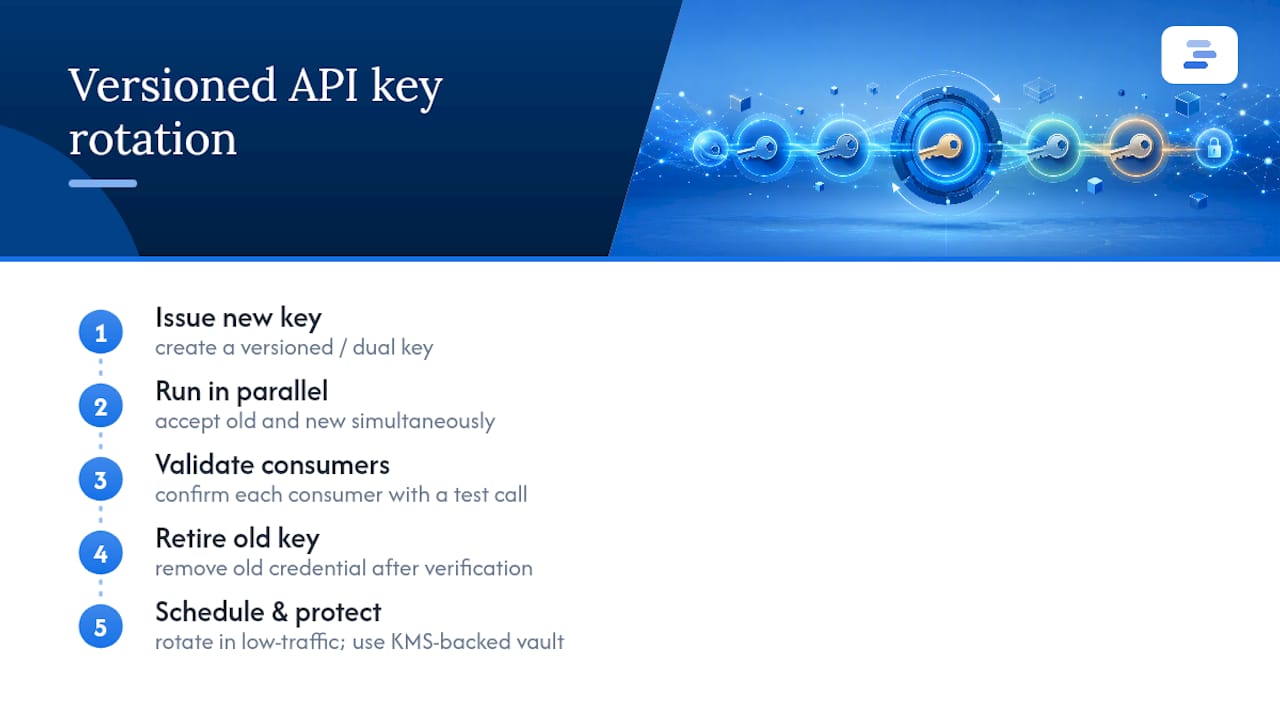
For rotation, avoid the "swap and pray" pattern. Use versioned or dual-key rotation: issue a new key, run it in parallel with the old one, confirm every consumer has switched over with a test call, then retire the original. Schedule rotation windows during low-traffic periods, and if your workloads touch regulated data, back your vault with a cloud KMS or customer-managed key so encryption policy isn't an afterthought.
How Do You Give Out Keys Without Leaking Them?
The moment you generate a key is often the riskiest moment in its life. Screenshots, Slack messages, and support tickets are where plaintext keys go to die in someone's search history.
Build your issuance flow around a few habits:
- Show the plaintext value exactly once, at creation, then never display it again. If someone loses it, issue a new one.
- For partner integrations, exchange credentials vault-to-vault or issue short-lived tokens instead of emailing a static key.
- Give every partner or service its own scoped credential. Shared keys make revocation impossible without breaking someone else's integration.
- Document onboarding in a runbook, and notify owners automatically when a key nears expiration.
This is less about clever tooling and more about discipline: copy-once, own-per-key, and no shortcuts for "just this one partner."
What Should You Monitor, and What's Your Incident Plan?
Logging a key's prefix and last four characters, alongside caller identity, source IP, endpoint, and request volume, gives you enough to spot trouble without storing the secret itself. Watch for the patterns that actually predict abuse: a login from a new geography, a staging key suddenly hitting production endpoints, or a request volume that spikes tenfold overnight.
When something looks wrong, speed beats elegance. A workable playbook runs like this:
- Identify the key's owner from your inventory.
- Issue a new key and switch traffic to it.
- Revoke the old key immediately, don't wait for confirmation from every downstream consumer.
- Run a short postmortem: how long was the window of exposure, and what would have caught it sooner?
Run this drill periodically, even when nothing's on fire. Teams that only test revocation during a real incident usually discover their "instant" revoke takes twenty minutes because of caching or a forgotten dependency. Measuring your actual cutover time is the only way to know your response time before it matters.
How Do You Keep Secrets Safe in CI/CD Pipelines?
Pipelines are secret-sprawl machines if you let them be. Inject credentials at runtime from your vault, or use short-lived tokens scoped to a single pipeline run, rather than baking a static key into a build image or repository variable that outlives its usefulness.

Mask every sensitive value in CI logs; a key printed once in a debug log is a key you have to treat as compromised. Keep secrets separated by environment, staging and production should never share a credential, and rotate each on its own schedule. If you cache secrets for performance, use a short TTL with automatic fallback to the secrets manager on a cache miss, so a stale cached value never outlives its rotation.
When Should You Replace API Keys With Something Stronger?
A bearer API key is a static credential: whoever holds it can use it, with no proof of who's actually calling. That's fine for a low-risk internal tool. It's a liability for anything touching payments, personal data, or regulated infrastructure.
NCSC guidance draws a clear line between authentication and authorization, and recommends OAuth 2.0 or OIDC wherever you need to delegate access without handing over a raw, reusable credential. For high-value endpoints, mTLS or OAuth2 should replace static keys outright. If a full migration isn't feasible yet, run a hybrid period: accept both the old key and the new token simultaneously, migrate consumers in batches, and set a hard cutoff date. Where identity propagation is possible at all, workload identity or IAM roles beat any long-lived key, static or not.
How Platform Tooling Reduces Key Management Friction
Manual key handling breaks down the moment your team grows past a handful of services. Embedding secret retrieval directly into your editor and CLI, rather than copy-pasting values between a vault dashboard and a config file, removes the exact moment where leaks happen. Workspace-level controls that tie keys to billing and team ownership give you an audit trail for free: who created a key, which model or environment it's scoped to, and how much it's being used. A typical workflow looks like this: a developer generates a scoped key for a specific model inside their workspace, uses it through an integrated CLI or extension, and rotates it from the same dashboard without ever touching a plaintext value twice.
What Actually Matters More Than People Think
Most teams treat key rotation as the hard part. It isn't. The hard part is inventory, knowing every key that exists and who's responsible for it, because an unowned key is a key nobody will rotate until it's already been abused.
I'd also push back on the instinct to over-engineer rotation before you've automated the basics. Versioned keys that run in parallel during a cutover solve the uptime problem better than any clever scheduling logic. And keep a running list of near-misses: the staging key that leaked into a public repo, the partner integration still using a key from three years ago. Those are your real audit trail, more useful than any compliance checklist.
— Jubba
A Developer-Focused Alternative For Managing Model Access
If your team is juggling API keys across multiple AI coding models on top of everything else, centralizing that access is worth doing before it becomes its own security problem. Sanad gives engineering teams a single account and workspace layer across models like Sanad 0.1, GLM 5.2, and DeepSeek V4 Pro, accessed through APIs, a Visual Studio Code extension, and a command-line interface, so you're not managing a separate credential for every model you want to try. Pay-as-you-go billing tied to token usage means cost tracking and access ownership live in the same place, which makes auditing who's using what far simpler than piecing it together across five different provider dashboards. If you want model access that's easier to scope and monitor from day one, start a Sanad workspace and bring your team's model usage under one roof.
Where to Go Deeper on Key Security Standards
For hands-on implementation, the OWASP API Security Project covers lifecycle failures in depth, NCSC's API authentication guidance explains the authentication versus authorization split, and AWS Secrets Manager's documentation walks through rotation automation you can adapt to any vault.
Sources
- Microsoft reducing NuGet API keys lifetime (Help Net Security)
- OWASP API Security Project
- NCSC — API authentication and authorisation guidance
- AWS Secrets Manager — Manage API keys for security-sensitive workloads