

Yes, your team should adopt AI code review, but treat it as a fast first-pass reviewer, not a substitute for human judgment on architecture and business logic. Independent benchmarks show real value here: hands-on evaluations find AI review most useful for PR summarization and cutting reviewer cognitive load, while humans stay in the loop for the calls that actually matter.
Start with a 2 to 4 week pilot. Run your existing static checks alongside an AI reviewer on real pull requests, and track two numbers from day one:
- Actionable-finding rate: how many flagged issues would you have fixed anyway, per PR
- Noise ratio: how many flagged issues you dismissed as false positives or irrelevant
If actionable findings climb and noise drops as you tune the config, you have a keeper. If the tool stays chatty after two weeks of adjustment, that's a signal worth acting on before you roll it out further.
Key Takeaways
Hybrid deterministic plus AI architectures consistently outperform pure LLM reviewers on both accuracy and noise, making them the safer default for production pilots.
| Point | Details |
|---|---|
| Pilot before committing | Run a 2 to 4 week trial tracking actionable findings and false-positive ratio before adopting any tool. |
| Favor hybrid architectures | Deterministic static analysis plus an AI layer scores highest on independent F1 benchmarks. |
| Budget real tuning time | Plan for 1 to 2 weeks of config tuning to cut noise before judging a tool's value. |
| Keep humans on judgment calls | AI review handles triage and summaries well; architecture and business logic still need a human reviewer. |
| Sanad fits the pilot model | Sanad's flexible model catalog, API/CLI/VS Code integrations, and pay-as-you-go billing suit teams testing before scaling. |
Table of Contents
- What Is AI Code Review and How Does It Work?
- How Accurate Is AI Code Review, Really?
- How Do You Evaluate an AI Code Review Tool?
- What Does Rollout Actually Look Like?
- How Does Sanad.dev Fit the Evaluation Checklist?
- What's the Real Impact on Developer Productivity?
- Where Has AI Code Review Actually Worked?
- Why Hybrid Beats Pure AI, and Why That's Underrated
- Get Production-Ready AI Code Review Without Locking Into One Model
- Sources
What Is AI Code Review and How Does It Work?
AI code review uses a language model, sometimes paired with static analysis, to read a pull request's diff and flag bugs, security issues, and style violations before a human reviewer looks at it. Three architectures dominate the market right now, and picking the wrong one for your codebase is the most common early mistake.
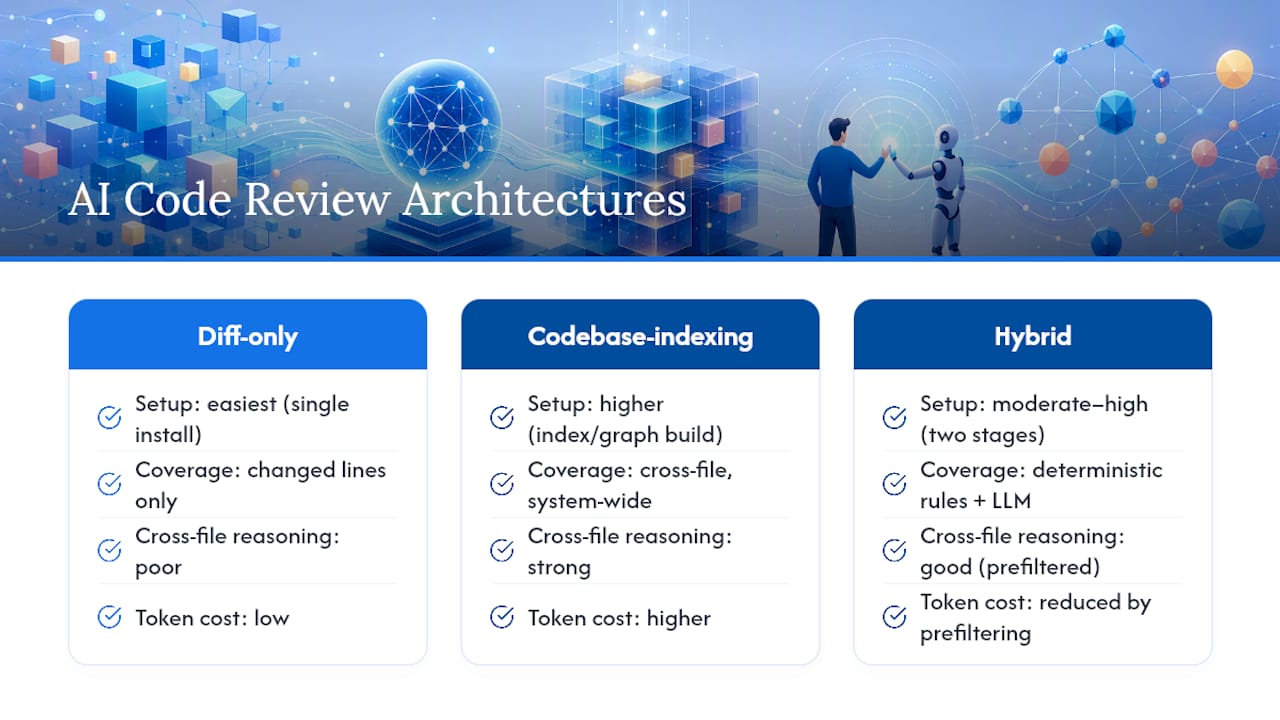
Diff-only LLM reviewers read just the changed lines and surrounding context. They're the easiest to adopt (often a single GitHub App install) but they miss cross-file dependencies and can misjudge intent when a function's caller lives three files away.
Codebase-indexing approaches build a graph or index of your repository so the model can reason about how a change ripples across the system. This costs more in setup and token usage but catches issues diff-only tools structurally cannot see.
Hybrid systems run deterministic static analysis first, then hand the results to an LLM agent for triage and explanation. This is the architecture behind the highest-scoring tools in independent testing, because deterministic rules catch known patterns reliably while the AI layer adds context and reduces false alarms. Alibaba's Open Code Review uses exactly this pattern at scale, running deterministic file selection and rule matching before the agent ever gets involved, which cuts both noise and token cost.

How Accurate Is AI Code Review, Really?
Accuracy varies more than most vendor pages let on. DeepSource's testing against the OpenSSF CVE Benchmark found F1 scores ranging from roughly 6% up to 84.51%, depending entirely on architecture. That's not a small spread. A tool at the bottom of that range will flood your pull requests with noise; a tool near the top will catch real vulnerabilities other tools miss entirely.
Pro Tip: Don't trust a single benchmark number in isolation. Ask any vendor which dataset and CVE set they tested against, then weigh that against your own stack's languages and frameworks.
The gap comes down to signal-to-noise ratio. A diff-only model might flag 40 issues on a mid-sized pull request, and a tired reviewer starts ignoring all of them, including the two that matter. A well-tuned hybrid system flags 6, and 5 are worth fixing. That difference is the entire product.
Watch for these specific failure modes:
- Hallucinated facts: the model confidently references a function, config value, or library behavior that doesn't exist in your codebase.
- Nondeterminism: the same diff reviewed twice produces two different sets of comments, which makes it hard to trust or reproduce results.
- Version and platform confusion: the model assumes a language version, framework convention, or runtime behavior your team abandoned two releases ago.
None of these are disqualifying on their own. They're reasons to pilot before you commit, and reasons to keep a human on anything touching security-critical paths or public APIs.
How Do You Evaluate an AI Code Review Tool?
Run every candidate through the same checklist during your trial so you're comparing apples to apples, not vibes to vibes.
- Detection accuracy and F1. Ask for the tool's performance against a public benchmark like the OpenSSF CVE set, and cross-check it against your own repo's known bug history if you can.
- Signal-to-noise ratio. Count actionable findings against total findings across a full week of real pull requests, not a cherry-picked demo repo.
- Platform coverage. Confirm native support for GitHub, GitLab, your IDE, and your CI/CD pipeline. A tool that only lives in one of those places will get skipped the moment work gets busy.
- Pricing model and setup time. Token-based billing needs a usage estimate before you commit budget; seat-based billing needs a headcount forecast.
- Data governance. For any repo with sensitive code, confirm retention policy, SOC 2 Type II status, and zero-data-retention options before you ever connect it.
During the trial itself, track actionable findings per pull request, false-positive ratio, reviewer time saved in minutes, and total setup hours. Those four numbers, tracked consistently across two or three tools, will tell you more than any sales deck.
Pro Tip: Budget setup hours as a real cost center, not a rounding error. Teams that skip this step end up blaming the tool for noise that a config file could have fixed in an afternoon.
What Does Rollout Actually Look Like?
Moving from trial to production follows a predictable rhythm, and most teams underestimate the tuning phase specifically.
- Install and discovery (day 1). Connect the repo, let the tool index your codebase or run its first diff-only pass, and review the baseline output with zero changes made yet.
- First-run calibration (days 2 to 5). Compare the tool's flagged issues against what your senior reviewers would have caught manually. This is where you spot obvious noise patterns fast.
- Config tuning (week 1 to 2). Use rule files to suppress known false-positive categories, enforce your team's actual style conventions, and mute checks that duplicate your existing linter. Hands-on evaluations consistently find this phase takes one to two weeks before noise drops to a workable level.
- Acceptance testing (week 3). Set a hard threshold, for example fewer than 3 noise comments per pull request and at least 60% actionable-finding rate, before you call the pilot a pass.
Config files deserve ongoing ownership, not a one-time setup. Treat them the way you'd treat your linter rules: reviewed periodically, updated when the codebase shifts, and owned by a specific person or team, not left to drift.
Pro Tip: Assign config ownership to whoever already owns your CI pipeline. They already have the habit of maintaining shared tooling, and it keeps tuning from becoming an orphaned task nobody prioritizes.
How Does Sanad.dev Fit the Evaluation Checklist?
Sanad gives you model flexibility as a built-in feature rather than a locked-in bet. You get access to a catalog that includes Sanad 0.1, GLM 5.2, GPT OSS 120B, and DeepSeek V4 Pro, so a quick style pass and a deep architectural review don't have to run on the same model. Pick a fast, cheap model for iterative diff checks, and switch to a stronger reasoning model when a pull request touches something riskier.
Integration follows the same flexibility. You can pilot through the API if you're building a pipeline-first workflow, install the Visual Studio Code extension if your team wants review feedback inline while coding, or drop into the command-line interface for CI-first setups. That range matters during a trial: you're not locked into one integration style before you know which one your team will actually use.
- Team workspace controls let you manage access without juggling shared credentials.
- Usage analytics give you the actionable-findings and reviewer-time data your evaluation checklist actually needs.
- Pay-as-you-go token billing keeps trial costs predictable instead of locked behind a seat-based contract.
- Model management and governance controls matter before connecting any repository with sensitive code.
| Point | Details |
|---|---|
| Model flexibility | Sanad's catalog spans fast iteration models and deeper reasoning models for the same codebase. |
| Integration range | API, VS Code extension, and CLI access support both IDE-first and pipeline-first pilots. |
| Predictable trial costs | Pay-as-you-go token billing avoids committing to a seat contract before you've measured value. |
What's the Real Impact on Developer Productivity?
The productivity gain from AI code review shows up less in "bugs caught" and more in reviewer time and merge velocity. When a first pass already flags the obvious issues, human reviewers spend their attention on logic and architecture instead of catching a missing null check for the third time that week.
Mean time to merge is the metric worth watching closely. If a hybrid AI review catches style and common bug patterns before a human ever opens the pull request, the human review cycle gets shorter, because the reviewer isn't starting from zero. Monterail's evaluation frames this as reduced cognitive load rather than a replacement for review depth, and that framing matters. The tool is doing triage, not judgment.
Code quality metrics tell a similar story but need context. A drop in post-merge bug reports is a good sign, but only if your team didn't simultaneously lower review rigor because "the AI already checked it." That's a real risk. Teams that treat an AI pass as a reason to skip human review entirely tend to see quality regress on exactly the changes that needed the most scrutiny: the ones touching shared state, authentication, or payment logic.
The honest way to measure this: track actionable findings per pull request and reviewer time saved in minutes as your two primary numbers, and watch mean time to merge as a secondary signal. If reviewer time drops but actionable-finding rate also drops, you've traded thoroughness for speed, which is not the trade you want.
Where Has AI Code Review Actually Worked?
The clearest adoption pattern shows up in teams that started small and scoped the tool's job narrowly. Rather than handing an AI reviewer full authority over every pull request from day one, successful rollouts tend to assign it a specific job, like flagging security patterns or catching style drift, and expand scope only after the noise ratio proves manageable.
Open-source ecosystems make this pattern visible. Projects like ai-code-reviewer demonstrate the specific features that drive adoption in practice: PR summaries that save a reviewer from reading the full diff cold, inline suggestion buttons that let a developer apply a fix with one click, and discovery caching that keeps repeated scans fast. Those small usability details, not raw model power, are often what determines whether a team keeps using a tool past the first month.
Large-scale, production-proven examples reinforce the same lesson from the other direction. Alibaba's Open Code Review architecture runs deterministic rule matching before any AI agent gets involved, a design choice made specifically to control token cost and precision at scale. That's not a startup's shortcut. It's what happens when an organization runs enough pull requests to feel every inefficiency in a review pipeline, and the answer they landed on was hybrid, not pure AI.
The common thread across both the small open-source projects and the large-scale system: nobody who succeeded treated AI review as a black box. They scoped it, measured it, and adjusted the split between deterministic rules and AI judgment until the noise dropped to something a reviewer would actually trust.
Why Hybrid Beats Pure AI, and Why That's Underrated
The conventional pitch for AI code review sells it as a replacement for tired human reviewers. That framing undersells what the data actually supports and oversells what any single model can do. It's the entire story: architecture matters more than which model you pick.
What gets underestimated is how much of the value sits in the deterministic layer, not the AI layer. A hybrid system's static analysis pass is doing unglamorous, reliable work, catching the known patterns that don't need a language model's judgment at all. The AI layer's job is triage and explanation on top of that foundation, not detection from scratch. Teams that skip the deterministic layer and go straight to a pure LLM reviewer are paying for flexibility they mostly don't need and getting noise they didn't budget for.
The reader's real priority should be measurement, not model selection. Pick a tool, track actionable-finding rate and reviewer time saved for a real month of pull requests, and let the numbers argue for themselves. Model flexibility, like what Sanad offers across its catalog, matters most once you know what you're actually measuring.
— Jubba
Get Production-Ready AI Code Review Without Locking Into One Model
Sanad is the alternative to committing your team to a single AI vendor before you've even finished your pilot. Where most code review tools lock you into one model and one pricing tier, Sanad gives you a full catalog, Sanad 0.1, GLM 5.2, GLM 4.7 Flash, GPT OSS 120B, DeepSeek V4 Flash, and DeepSeek V4 Pro, so you can run fast, cheap models for routine diffs and switch to deeper reasoning models the moment a pull request touches something riskier.
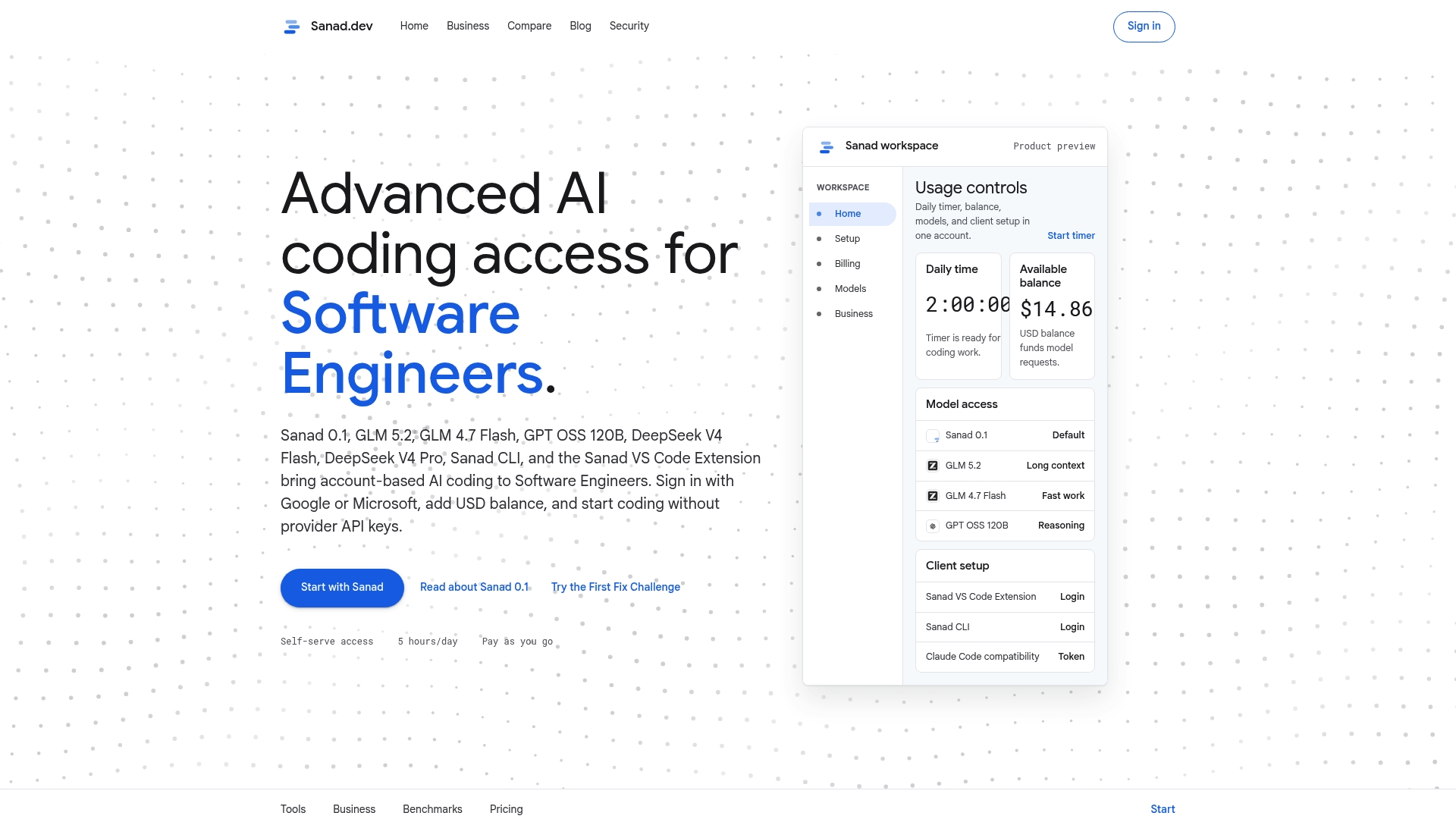
That flexibility matters most during the exact evaluation phase this article walked through. You need to compare detection accuracy, signal-to-noise, and setup effort across more than one model, and Sanad lets you do that inside a single account instead of juggling multiple vendor contracts. Integration follows your team's actual workflow: the API for pipeline-first setups, the Visual Studio Code extension for inline review while you code, or the command-line interface if your review process lives in CI. Pay-as-you-go token billing keeps a trial's cost visible from the first pull request, and workspace controls with usage analytics give you the actionable-finding and reviewer-time data your evaluation checklist needs.
Start your pilot today by creating a Sanad account and connecting your first repository through the integration that fits your team's workflow.